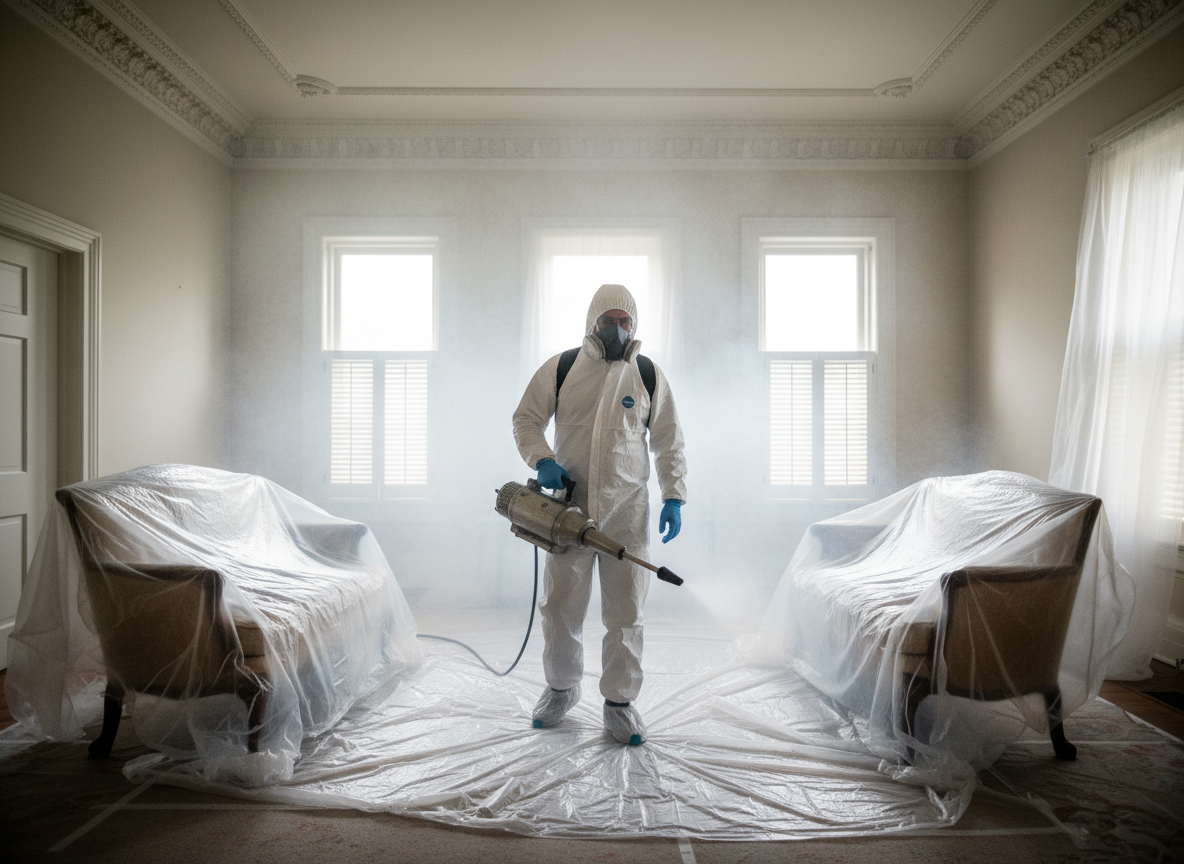
Mold fogging treatment uses a fine mist of EPA-registered antimicrobial agents dispersed under pressure to penetrate wall cavities, attics, and subfloor areas common in Winnetka's 1950s-1970s ranch homes. These properties often feature limited attic ventilation and slab-on-grade construction that traps moisture from roof leaks or plumbing penetrations, allowing colonies to form behind drywall and insulation where surface wipes cannot reach. The process requires pre-treatment containment with plastic sheeting and negative air machines to keep spores from migrating into living spaces during application.
In Los Angeles County's mild Mediterranean climate, warm dry summers reduce visible surface moisture yet leave residual humidity in poorly vented spaces near Winnetka Park and Pierce College. Fogging agents must be selected for low volatility so they remain active long enough to contact spores without leaving residues that affect indoor air once the home is reoccupied. Technicians monitor humidity levels before and after treatment because even brief winter rains can reintroduce moisture through stucco cracks typical in Sherwood Forest and Reseda-adjacent streets.
Homeowners sometimes attempt DIY foggers sold online, but these lack the particle size control and containment protocols needed to avoid pushing spores into HVAC systems that serve multiple rooms in single-story Winnetka houses. Professional application includes post-fogging air scrubbing and clearance sampling to confirm spore counts have dropped below outdoor baselines before barriers are removed.
Technician insight
In Winnetka, the thing that catches most people out with mold fogging treatment is the 1960s ranch homes in Sherwood Forest where shallow roof pitches and single-layer stucco let occasional winter rain seep into wall cavities that stay warm and dry all summer, hiding growth until the fog reaches it.
Attic Mold Fogging in Sherwood Forest
A Winnetka homeowner noticed musty odors after a winter leak near the chimney. Inspection found hidden colonies on insulation in the low-pitch attic common to local 1960s homes. We contained the space, applied fog through access points, ventilated, and cleared the air. The odor disappeared and no demolition was needed.
How it works
- 1
Initial Containment Setup
Seal off affected rooms with plastic sheeting and negative air machines to prevent spore migration through the home's open floor plans.
- 2
Pre-Treatment Inspection
Use moisture meters and borescopes to locate hidden growth in attics and crawl spaces common in local post-war construction.
- 3
Fog Application
Disperse antimicrobial fog under controlled pressure to reach wall cavities and insulation without removing drywall.
- 4
Ventilation and Clearance
Air scrub affected zones then test air samples to confirm spore reduction before reopening the space.
Pricing
Pricing depends on square footage treated, number of hidden cavities, and whether HVAC cleaning is required; request an on-site assessment for an upfront quote.